25 min read
What Is a Life Safety Compliance Audit Trail — And How It Differs From a Standard Work Order History
Understand the precise difference between a compliance audit trail and a CMMS work order history — and why CMS surveyors treat them as fundamentally different evidence.
By Benjamin Terebelo

A CMS surveyor walks into your skilled nursing facility on a Tuesday morning without notice. Within the first hour, they ask for your fire drill records, your generator test logs, and the corrective action documentation for a sprinkler deficiency flagged during your last annual inspection. You open your CMMS, pull the work order history, and hand over a printout. The surveyor reviews it, sets it aside, and marks a K-tag citation.
That scenario plays out across SNFs every year, and the maintenance directors involved are genuinely confused afterward. They did the work. The inspections happened. The work orders are right there in the system. So why did the citation stand?
The answer lies in a distinction most facility teams never encounter until they are sitting across a table from a surveyor: the difference between a compliance audit trail and a work order history. These two things look similar on the surface. They both involve records of completed tasks. But they serve fundamentally different evidentiary purposes, and CMS treats them as fundamentally different categories of evidence. Understanding that distinction is not a technicality. It is the difference between surviving an unannounced survey and receiving a citation for work you actually performed.
What a Work Order History Actually Is (and What It Was Designed to Do)
A CMMS work order record is an operational tool. It was designed to help maintenance teams schedule, assign, and track the completion of repair and inspection tasks across a facility. When a technician completes a fire extinguisher check, closes the work order, and logs the date and their name, the CMMS has done exactly what it was built to do: it has captured that the task was completed.
The problem is that operational completion is not the same as regulatory compliance evidence. A work order record answers the question "did we do the task?" A compliance audit trail answers a fundamentally different set of questions: "Did we do the right task, at the right interval, with the right observations recorded, by a qualified person, at the time the task was performed, and can we prove all of that without reconstructing anything after the fact?"
Most CMMS platforms were built for hospitals, commercial real estate, and manufacturing environments where the documentation standard is operational continuity. If a pump fails and a technician replaces a seal, the work order records what was done, when, and by whom. That is sufficient for maintenance management. It is not sufficient for a CMS surveyor evaluating compliance with NFPA 101 or NFPA 99.
The Four Ways Work Order Histories Fall Short of Compliance Evidence
When a CMS surveyor reviews facility documentation, they are not simply verifying that tasks occurred. They are evaluating whether the documentation itself meets the standard of contemporaneous, complete, and regulation-specific evidence. Here is where standard CMMS work order records consistently fall short:
- Timestamp integrity. Many CMMS platforms allow work orders to be closed after the fact, sometimes days or weeks after a task was performed. A work order closed on a Friday for an inspection that supposedly occurred the previous Monday does not establish contemporaneous documentation. Surveyors are trained to look for exactly this pattern.
- Missing observation data. A work order that records "fire extinguisher inspected, pass" is operationally complete. A compliant inspection record requires the specific observations called for by NFPA 10: the pressure reading, the condition of the tamper seal, the inspection date relative to the last service date, and the identity of the inspector. A CMMS work order rarely captures all of these fields because it was not designed to enforce NFPA-specific data capture.
- No regulatory cross-reference. Work orders track assets and tasks. Compliance audit trails track assets, tasks, and their relationship to specific regulatory requirements. When a surveyor asks for documentation supporting a K-tag category, they need to see not just that a task was done, but that the task was done in response to a specific regulatory obligation and at the required frequency. Standard CMMS records do not carry that regulatory context.
- No gap visibility. A work order history shows what was completed. It does not surface what was missed, what was overdue, or what was completed at an incorrect interval. A compliance audit trail is designed to make those gaps visible before a surveyor finds them.
None of this means CMMS platforms are useless. They are excellent at what they were designed for. The issue is that SNF maintenance directors have been trying to use an operational tool to satisfy a regulatory evidentiary standard it was never designed to meet. That mismatch is the source of most preventable life safety citations.
Defining the Compliance Audit Trail: What CMS Actually Expects to See
A life safety compliance audit trail is a structured, regulation-specific, time-stamped record of inspections, tests, and corrective actions that can be evaluated by a CMS surveyor as evidence of ongoing regulatory compliance. The distinction matters because CMS surveyors operating under the CMS Life Safety Code Survey Protocol are not evaluating whether your maintenance team is competent. They are evaluating whether your documentation demonstrates compliance with specific regulatory standards at specific intervals.
A compliant audit trail has several structural characteristics that a work order history typically lacks:
Contemporaneous Capture
Contemporaneous documentation means the record was created at the time of the inspection, not reconstructed from memory afterward. This is one of the most significant evidentiary distinctions CMS surveyors draw. When a technician completes a monthly generator test and logs the results on a paper form immediately after the test, that is contemporaneous documentation. When a maintenance director reconstructs three months of generator test logs from memory the week before a survey, that is not, regardless of whether the tests actually occurred.
The challenge with paper-based documentation systems is that they create constant pressure toward reconstruction. Forms get lost. Binders fill up. A technician completes a test and sets the form on their workbench, intending to file it later. Three weeks later, the form is gone and the entry gets reconstructed from whatever the technician remembers. This is the most common documentation pattern that produces citations for work that was actually performed.
A genuine compliance audit trail enforces contemporaneous capture by design. The inspection form is completed in the field, at the time of the inspection, using a mobile device, kiosk, or back-office terminal. The system timestamps the entry at the moment of submission, not at the moment of entry. Those timestamps are immutable. A surveyor reviewing the record can see not just that the inspection was completed, but when the documentation was created relative to when the inspection was supposed to occur.
NFPA-Specific Data Fields
Different inspection types require different data fields under NFPA 101, NFPA 99, and NFPA 72. A generator test log must capture kilowatt load readings, transfer switch operation, coolant temperature, and runtime duration. A fire drill record must capture the shift, the date and time, the number of staff participating, the floor or wing covered, and any deficiencies identified. A sprinkler inspection record must capture the areas inspected, the inspector's credentials, and any impairments or deficiencies noted.
A CMMS work order typically has a notes field and a completion checkbox. It does not enforce NFPA-specific data capture because its architecture is asset-agnostic. A compliance audit trail built for SNF life safety embeds the specific data fields required for each inspection type directly into the inspection form, making it impossible to "complete" an inspection without capturing the required observations. That data enforcement is what transforms a completion record into a compliance record.
Regulatory Interval Tracking
NFPA standards define specific inspection intervals: monthly, quarterly, semi-annual, annual, and in some cases weekly. A compliance audit trail tracks not just whether an inspection was completed, but whether it was completed within the required interval. A generator test completed 34 days after the previous test may or may not represent a compliance issue depending on the applicable standard and the reason for the gap. A standard work order history will show both completions without flagging the interval. A compliance audit trail will flag the gap and require documentation of the reason.
This interval tracking is what transforms a passive record-keeping system into an active compliance management tool. The surveyor is not just asking "did you test the generator?" They are asking "did you test the generator every month, within the required interval, and do you have documentation proving that?" Those are different questions, and they require different evidence.
Corrective Action Linkage
When an inspection identifies a deficiency, a compliant audit trail links the deficiency to a corrective action record and tracks that corrective action to resolution. The deficiency record, the corrective action assignment, the completion documentation, and the follow-up verification all exist as a connected chain within the same system. A surveyor can trace the full lifecycle of a deficiency from identification to resolution in a single review.
In a standard CMMS, a deficiency identified during an inspection might generate a new work order. But the connection between the original inspection record and the corrective work order is often informal or manual. If the corrective work order is closed without a reference back to the original inspection, the chain of evidence is broken. A surveyor who finds an unresolved deficiency in your inspection records and cannot locate the corresponding corrective action documentation will treat that as an open deficiency regardless of whether the repair was actually made.
The Contemporaneous Inspection Log: Why "After the Fact" Is a Fatal Documentation Pattern
The concept of the contemporaneous inspection log sits at the center of almost every disputed life safety citation. It is worth examining in detail because the pattern of after-the-fact reconstruction is so common in SNF operations that many maintenance directors do not recognize it as a documentation failure at all.
Consider a common scenario: a maintenance technician performs weekly fire door inspections every Monday morning. The facility uses a paper-based checklist. On a given Monday, the technician completes the inspections but leaves the checklist on his workbench because the fire alarm is testing and he gets pulled away. On Friday, he finds the checklist and fills it out from memory, dating it Monday. The inspection actually happened. The documentation is accurate to the best of his recollection. But the document was not created contemporaneously.
A trained CMS surveyor will often identify this pattern through indirect evidence: handwriting analysis of bulk entries, identical timestamps across multiple records, documentation created in batches rather than incrementally, and the absence of minor corrections or observations that are characteristic of real-time documentation. When surveyors identify this pattern, the documentation loses its evidentiary value regardless of whether the underlying inspections occurred.
The contemporaneous inspection log difference is not a procedural formality. It goes to the heart of what documentation is supposed to accomplish in a regulatory context. Documentation is supposed to be a contemporaneous record of what occurred, not a post-hoc reconstruction of what is believed to have occurred. When documentation serves as evidence of compliance, its value depends entirely on its integrity as a contemporaneous record.
How Digital Capture Changes the Evidentiary Standard
Digital inspection platforms change the evidentiary dynamic in several important ways. When a technician completes an inspection using a mobile device or facility kiosk and the system logs a server-side timestamp at the moment of submission, that timestamp becomes an independent piece of evidence that the documentation was created at a specific time. The technician cannot go back and change the timestamp. The maintenance director cannot batch-enter records for the previous month.
This immutability is precisely what makes digital contemporaneous documentation stronger evidence than paper documentation. It is not that paper documentation is inherently less reliable; it is that paper documentation cannot demonstrate its own contemporaneous character in the way that a timestamped digital record can. A surveyor reviewing digital records with immutable server-side timestamps has objective evidence of when documentation was created. A surveyor reviewing paper records has only the date written on the form, which could have been written at any time.
For SNF maintenance directors, this means that transitioning from paper to digital documentation is not just an operational improvement. It is an evidentiary upgrade that changes the quality of evidence available to defend compliance during a survey.
How CMS Surveyors Actually Evaluate Documentation: The K-Tag Framework
To understand why the compliance audit trail matters, it helps to understand how CMS surveyors organize their evaluation of life safety documentation. CMS uses a K-tag system to categorize life safety deficiencies under the Life Safety Code. Each K-tag corresponds to a specific regulatory requirement, and surveyors evaluate documentation through the lens of K-tag compliance.
When a surveyor evaluates K-tag documentation, they are asking a structured set of questions:
- Does the facility have documentation demonstrating awareness of the regulatory requirement?
- Does the documentation show that the required inspections or tests were performed at the required frequency?
- Does the documentation capture the specific observations required by the applicable NFPA standard?
- Where deficiencies were identified, does the documentation show corrective action and resolution?
- Is the documentation contemporaneous, or does it appear to have been reconstructed?
A standard CMMS work order history can sometimes answer question one and question two. It rarely answers questions three through five in a way that satisfies a surveyor. A compliance audit trail built specifically for SNF life safety documentation is designed to answer all five questions for every inspection type across every K-tag category.
The Most Commonly Cited K-Tag Documentation Failures
Based on the structure of CMS Life Safety Code enforcement, several K-tag categories consistently produce documentation-related citations rather than actual compliance failures. These are situations where the required work was performed but the documentation did not meet the evidentiary standard:
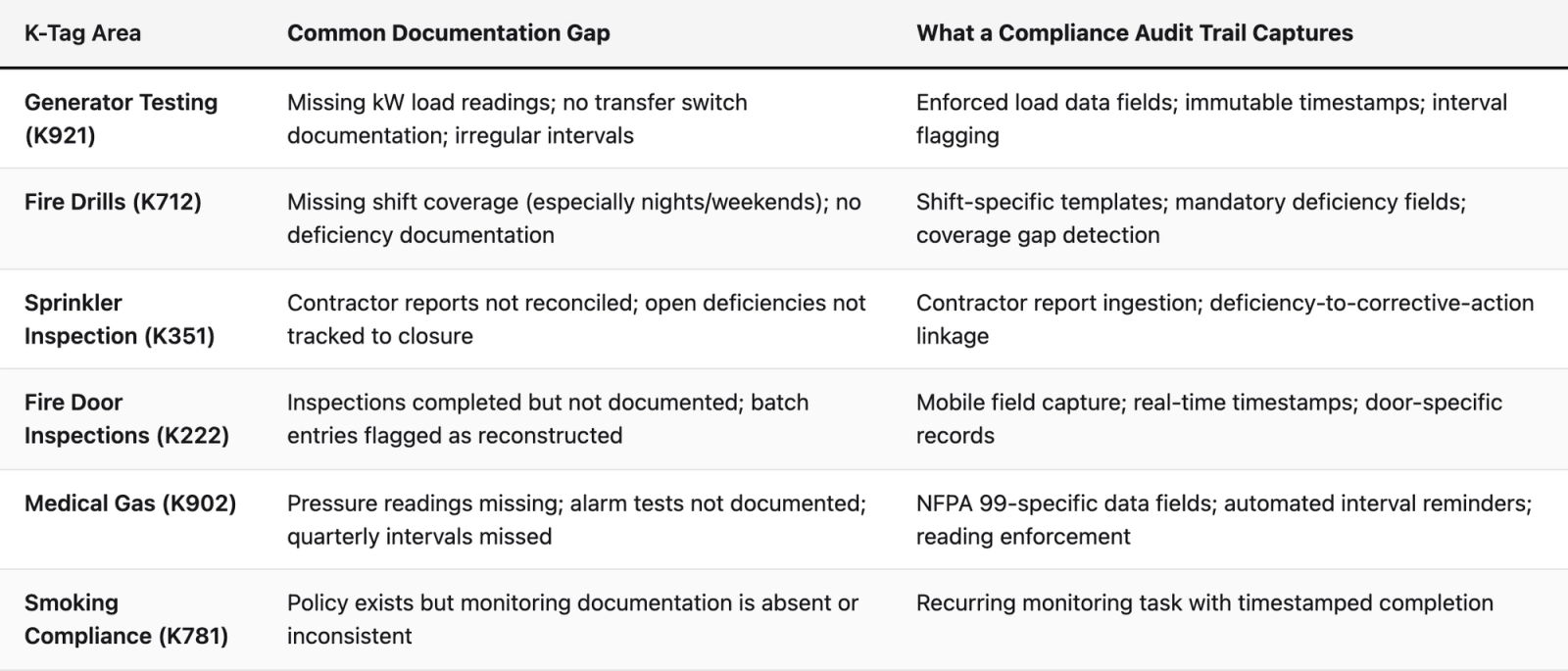
The pattern across all of these categories is consistent: the citation is not about whether the facility understood the requirement or performed the work. It is about whether the documentation can independently demonstrate compliance. That is the standard a compliance audit trail is designed to meet.
The SNF Documentation Audit Trail vs. the Generic Healthcare Compliance Record
Not all compliance documentation systems are equivalent, and the differences matter significantly for SNF operators. Healthcare facilities operate under a broad range of documentation requirements: patient records, medication administration logs, care plans, incident reports, and environment of care documentation. Many electronic health record (EHR) systems and general compliance platforms include some form of documentation management for these categories.
But life safety compliance documentation for SNFs has specific characteristics that make general healthcare documentation platforms inadequate. The requirements are defined by NFPA standards rather than clinical standards, the inspection intervals are determined by physical system types rather than patient care protocols, and the evidentiary standard is defined by CMS Life Safety Code survey protocols rather than clinical documentation standards.
Why General Compliance Platforms Miss the Mark
A general compliance platform built for healthcare might include a task management module, a document storage repository, and a reporting dashboard. Those features address operational needs. They do not address the specific evidentiary requirements of a CMS life safety survey because:
- They lack NFPA-specific task templates with required data fields for each inspection type.
- They do not cross-reference task completions against regulatory intervals and flag gaps proactively.
- They do not link inspection deficiencies to corrective action records and track resolution.
- They do not surface the specific patterns of missing documentation that produce K-tag citations.
- They were not designed with the CMS Life Safety Code survey protocol as the evidentiary standard.
The result is a system that looks like a compliance platform but functions like a digital filing cabinet. It stores records without auditing them. It captures completions without verifying whether completions are compliant. It provides documentation without providing survey confidence.
The distinction between a life safety compliance platform and a general documentation system is the same as the distinction between a compliance audit trail and a work order history: one was designed for operational management, the other was designed for regulatory evidence.
What SNF-Specific Documentation Platforms Do Differently
A platform built specifically for SNF life safety compliance operates from a fundamentally different design premise. Instead of starting with task management and adding compliance features, it starts with the CMS Life Safety Code survey protocol and builds documentation workflows that generate evidence capable of withstanding surveyor scrutiny.
That means the task template library is built from NFPA 101, NFPA 99, NFPA 72, NFPA 10, and applicable state regulations, not from generic maintenance best practices. It means the inspection forms enforce the specific data fields required by each standard, not just a generic notes field. It means the system tracks intervals against regulatory requirements and flags gaps before they become citations. And it means the system reads completed records and contractor reports with an analytical layer that identifies the specific documentation patterns that produce K-tag citations.
This is the difference between a tool that helps a maintenance director do their job and a tool that helps a facility prove it did its job to the satisfaction of a CMS surveyor.
The AI Review Layer: Turning Completed Records Into Audit Intelligence
One of the most significant gaps in traditional documentation systems, whether paper-based or CMMS-based, is that they are passive. They record what happened. They do not analyze what the record means from a regulatory perspective. A maintenance director reviewing their own documentation may not recognize that a generator test log is missing a required kW load reading, or that fire drill records for the previous 12 months do not include a night-shift drill on a specific wing. These are subtle patterns that require regulatory expertise to identify.
This is where analytical review of completed documentation changes the equation. When a system reads completed inspection records and cross-references them against the regulatory expectations for each asset type and K-tag category, it can surface documentation gaps that would otherwise be invisible until a surveyor identifies them. Missing data fields. Irregular intervals. Deficiencies without corrective action records. Contractor reports that identify impairments never reconciled against an abatement plan.
These are not hypothetical failure modes. They are the specific patterns that produce the majority of life safety citations in SNFs. And they are consistently invisible to the people doing the documentation because the people doing the documentation are focused on completing tasks, not on auditing their own records for regulatory compliance patterns.
From Reactive to Predictive: The Documentation Intelligence Shift
The traditional documentation model in SNF life safety is fundamentally reactive. Documentation is created, stored, and only evaluated when a surveyor asks for it. Gaps are discovered at the moment of survey, when they are no longer correctable. The citation is issued, the plan of correction is filed, and the facility spends months in remediation for a documentation failure that might have taken thirty minutes to correct had it been identified three weeks earlier.
Predictive documentation auditing inverts this model. Instead of waiting for a surveyor to identify gaps, the system continuously reviews completed records against regulatory expectations and surfaces gaps in real time. The maintenance director sees that the generator test log from last Tuesday is missing the transfer switch documentation before the surveyor does. The director of facilities sees that the quarterly sprinkler inspection for the east wing is overdue by eleven days before the survey team arrives.
This shift from reactive record-keeping to predictive audit intelligence is the core value proposition of a life safety compliance platform built specifically for SNFs. It does not just capture documentation. It audits documentation against the same standard a CMS surveyor would apply, continuously, so that gaps are found and closed before they become citations.
Practical Implications for Maintenance Directors and Plant Operations Managers
For the maintenance director or plant operations manager responsible for life safety documentation at a SNF, the distinction between a compliance audit trail and a work order history has direct operational implications. Understanding those implications helps clarify what changes are actually necessary to achieve survey confidence.
Transitioning From CMMS Work Orders to Compliance Documentation
A CMMS is not the enemy. For work order management, asset tracking, and maintenance scheduling, it remains a useful operational tool. The issue arises when the CMMS work order record is treated as compliance documentation. The transition required is not necessarily replacing the CMMS, but supplementing it with a documentation layer that generates compliant audit evidence for the specific inspection types that CMS surveys evaluate.
In practical terms, this means:
- Completing NFPA-specific inspections using inspection forms that enforce required data fields, not generic work order completion records.
- Capturing inspection documentation at the time of the inspection, using a mobile device or kiosk, not retroactively from memory or paper forms.
- Tracking inspection intervals against regulatory requirements, not just against maintenance schedules.
- Linking deficiency findings to corrective action records and tracking resolution within the same system.
- Reviewing completed documentation periodically, or using a system that reviews it continuously, for the specific patterns that produce K-tag citations.
For maintenance directors managing this documentation alone, the analytical review layer is particularly important. A maintenance director responsible for hundreds of recurring inspection tasks across dozens of asset categories cannot be expected to simultaneously complete inspections and audit their own documentation for subtle regulatory compliance patterns. That is not a reasonable expectation. It is why so many SNFs with genuinely compliant operations still receive documentation-based citations.
The Multi-Site Operator Dimension
For regional facility managers and VPs of operations at multi-site SNF operators, the compliance audit trail has an additional dimension: portfolio-level visibility. When each facility maintains its own paper binder or CMMS work order history, regional managers have no systematic way to identify documentation gaps across the portfolio before a survey. They may know that Facility A has a strong maintenance director and Facility B has been dealing with staffing turnover, but they cannot see that Facility B's generator test logs have been missing kW load readings for three months until a surveyor flags it.
A compliance documentation platform that operates across multiple facilities creates the visibility necessary for proactive regional management. A regional facilities manager can see, in a single dashboard, which facilities have overdue inspections, which have open deficiencies without corrective action records, and which have documentation patterns that represent elevated survey risk. That portfolio visibility is not available from individual CMMS systems or paper binders.
For SNF operators managing ten, twenty, or fifty facilities, this visibility is not a convenience. It is a fundamental operational requirement for managing survey risk at scale. A single K-tag citation at one facility creates administrative burden. A pattern of documentation failures across a portfolio creates regulatory exposure that can affect operating licenses and CMS certification.
The Paper Binder Problem: Why Digitization Alone Is Not the Answer
Many SNF operators who recognize the limitations of paper-based documentation conclude that the solution is digitization: scanning paper records, moving to a digital storage system, or using a CMMS more consistently. Digitization is an improvement over paper. But it is not the same as implementing a compliance audit trail, and the distinction matters.
A scanned paper record stored in a digital repository is still a paper record. It was created using the same process, with the same documentation gaps, and with the same absence of regulatory data field enforcement. The only thing that changed is the storage medium. A surveyor reviewing digital scans of paper inspection forms will evaluate them by exactly the same evidentiary standard as the paper originals. If the forms are missing required data fields, if the completion dates appear to have been added in bulk, or if the intervals between inspections are irregular, those deficiencies are equally visible in digital form.
Similarly, moving from a paper task list to a CMMS work order system digitizes the task management process but does not transform work order records into compliance audit trail documentation. The fundamental architectural difference between a work order and a compliance record remains regardless of whether either exists on paper or in a digital system.
What Genuine Compliance Documentation Infrastructure Looks Like
A genuine compliance documentation infrastructure for a SNF has several characteristics that distinguish it from a digitized paper system or a repurposed CMMS:
- Inspection forms that are specific to the asset type and regulatory requirement, not generic task completion forms.
- Required data fields that cannot be bypassed or left blank for regulatory-critical observations.
- Immutable timestamps created at the server level when documentation is submitted, not editable date fields.
- Interval tracking that compares inspection completion dates against regulatory requirements and flags gaps automatically.
- Deficiency tracking that links inspection findings to corrective action records and monitors resolution.
- Analytical review that reads completed records and identifies the specific documentation patterns associated with K-tag citations.
- Audit-ready output that presents documentation in the format and organization a CMS surveyor expects to review.
This infrastructure is what a life safety compliance platform provides. It is architecturally different from a CMMS, a digital filing system, or a general compliance platform, because it was designed from the ground up to generate documentation that meets the CMS Life Safety Code survey evidentiary standard.
SNF Administrators and the Accountability Gap
For SNF administrators, the distinction between a compliance audit trail and a work order history represents an accountability gap that is easy to overlook until a survey makes it visible. Administrators typically hold ultimate accountability for CMS survey outcomes, but the documentation that determines those outcomes is generated by maintenance directors, technicians, and EVS staff working independently in the field. The administrator often has no direct visibility into whether that documentation meets the evidentiary standard CMS applies.
In practice, this means that an administrator can walk into a survey confident that their maintenance team is doing excellent work and still receive significant K-tag citations because the documentation of that work does not meet the compliance audit trail standard. The work happened. The compliance was real. But the evidence of compliance was not audit-ready.
This accountability gap is the operational reality that a life safety compliance platform is designed to close. When documentation is captured contemporaneously, enforced to NFPA-specific data field requirements, tracked against regulatory intervals, and continuously reviewed for compliance patterns, the administrator has real visibility into the evidentiary quality of their documentation, not just the operational completion of tasks.
That visibility is what transforms documentation from an administrative burden into a strategic asset. When a surveyor arrives, the administrator does not need to hope that the binder is complete. They know it is complete, because the system has been auditing it continuously.
Frequently Asked Questions
What is the difference between a CMMS work order record and a compliance audit trail?
A CMMS work order record documents that a task was completed. A compliance audit trail documents that a task was completed at the correct regulatory interval, with the specific observations required by the applicable NFPA standard, by a qualified person, at the time the task was performed, with deficiencies linked to corrective action records. Work orders are designed for operational management. Compliance audit trails are designed to function as regulatory evidence under CMS Life Safety Code survey scrutiny.
Why do CMS surveyors treat work order histories differently from compliance documentation?
CMS surveyors are evaluating documentation as evidence of regulatory compliance, not operational competence. A work order history demonstrates that tasks were assigned and closed. It does not demonstrate that the specific observations required by NFPA 101, NFPA 99, or NFPA 72 were captured, that inspections occurred at the correct regulatory intervals, or that deficiencies were identified and resolved. Surveyors apply an evidentiary standard that work order records were not designed to meet.
What does "contemporaneous" documentation mean in a CMS survey context?
Contemporaneous documentation means the record was created at the time the inspection or test was performed, not reconstructed afterward. CMS surveyors are trained to identify signs of retroactive documentation, including batch entries, identical timestamps across multiple records, and the absence of minor corrections or observations characteristic of real-time documentation. Documentation that appears to have been reconstructed loses its evidentiary value regardless of whether the underlying inspections actually occurred.
Which K-tag categories most commonly produce documentation-based citations?
Generator testing (K921), fire drills (K712), sprinkler inspections (K351), fire door inspections (K222), and medical gas systems (K902) consistently produce documentation-related citations in SNF surveys. In most cases, the underlying inspections were performed but the documentation did not capture the required data fields, did not demonstrate correct intervals, or did not link deficiencies to corrective action records.
Can a CMMS platform be configured to function as a compliance audit trail?
Some CMMS platforms can be partially configured to improve documentation quality, but the fundamental architectural limitations remain. CMMS platforms were not designed to enforce NFPA-specific data fields, track inspections against regulatory intervals, link deficiencies to corrective action records, or analyze completed documentation for compliance patterns. Significant custom configuration may close some gaps, but it typically requires ongoing maintenance and does not provide the analytical review layer that identifies compliance documentation gaps proactively.
What is the SNF documentation audit trail standard for generator testing?
Generator testing documentation for SNFs must capture, at minimum, the date and start time of the test, the duration of the test, the kilowatt load during the test (demonstrating that the load requirement was met), transfer switch operation, oil pressure, coolant temperature, and any abnormalities observed. The test must occur at the required monthly interval with documentation of the reason for any gap. A work order that records "generator test completed" without these data fields does not meet the compliance documentation standard under NFPA 99.
How does a life safety compliance platform differ from a general compliance management system?
A general compliance management system provides task management, document storage, and reporting for broad healthcare compliance functions. A life safety compliance platform is built specifically around NFPA standards and the CMS Life Safety Code survey protocol. It includes NFPA-specific task templates with required data field enforcement, regulatory interval tracking, deficiency-to-corrective-action linkage, and analytical review of completed documentation for K-tag citation patterns. These are architecturally different tools designed for different evidentiary standards.
What should SNF maintenance directors do to close the gap between their current documentation and a compliance audit trail?
The most effective immediate steps are: (1) audit current inspection forms against the specific data field requirements in the applicable NFPA standards for each inspection type; (2) identify any inspection types where documentation is being created retroactively from memory rather than contemporaneously in the field; (3) review deficiency records to confirm that all open deficiencies are linked to corrective action records and tracked to resolution; (4) compare inspection completion dates to required intervals to identify gaps; and (5) evaluate whether the current documentation system can produce audit-ready output organized by K-tag category for a surveyor review.
Does transitioning to digital documentation automatically create a compliance audit trail?
No. Digitizing paper records or moving to a CMMS improves operational efficiency but does not automatically create a compliance audit trail. A scanned paper form has the same documentation gaps as the original paper form. A CMMS work order record has the same evidentiary limitations in digital form as it does on paper. The compliance audit trail requires specific architectural features: NFPA-specific data field enforcement, immutable server-side timestamps, regulatory interval tracking, and deficiency linkage. These are not features of standard digitization tools.
How do multi-site SNF operators benefit from a compliance audit trail platform?
Multi-site operators benefit from portfolio-level visibility into documentation quality across all facilities. A compliance platform that operates across multiple sites allows regional managers to identify overdue inspections, open deficiencies without corrective action records, and documentation patterns representing elevated survey risk at any facility in real time. This visibility is not available from individual CMMS systems or paper binders, and it enables proactive risk management rather than reactive remediation after a citation is issued.
What role does an AI review layer play in compliance documentation?
An AI review layer reads completed inspection records, contractor reports, and shift logs and cross-references them against regulatory expectations for each asset type and K-tag category. It surfaces documentation gaps that are invisible to the people doing the documentation: missing data fields, irregular intervals, unreconciled contractor deficiencies, fire drill coverage gaps, and other patterns that consistently produce K-tag citations. This analytical review transforms the documentation system from a passive record-keeping tool into a proactive compliance audit function.
How quickly can documentation gaps be corrected once identified?
Many documentation gaps can be corrected in hours or days once identified. A missing kW load reading requires scheduling a supplemental generator test with proper documentation. A fire drill missing night-shift coverage requires scheduling and completing the missing drill. An open sprinkler deficiency without a corrective action record requires creating the record and documenting the resolution. The key is identifying these gaps before a surveyor does, because gaps identified proactively can be corrected while gaps identified during a survey result in citations.
Key Takeaways
- Work order history and compliance audit trail are fundamentally different evidentiary categories. One demonstrates operational task completion. The other demonstrates regulatory compliance to the standard CMS surveyors apply during Life Safety Code surveys.
- Contemporaneous documentation is a core evidentiary requirement. Documentation created at the time of the inspection, with immutable timestamps, has significantly stronger evidentiary value than documentation that could have been reconstructed after the fact.
- NFPA standards require specific data fields that generic CMMS work orders do not enforce. Generator tests, fire drills, sprinkler inspections, and other regulated inspection types each require specific observations that must be captured to satisfy the compliance documentation standard.
- Regulatory interval tracking is as important as task completion tracking. A surveyor evaluating compliance is asking whether inspections occurred at the correct interval, not just whether they occurred at all.
- Deficiency-to-corrective-action linkage is required for a compliant audit trail. An inspection that identifies a deficiency must be linked to a corrective action record, and that record must be tracked to resolution. Broken chains of evidence are treated as open deficiencies.
- Digitization without compliance architecture does not create a compliance audit trail. Moving from paper to digital storage improves operational efficiency but does not close the evidentiary gap between a work order record and a compliance audit trail.
- Analytical review of completed documentation is the gap most SNFs have not closed. Identifying documentation gaps requires reading completed records against regulatory expectations, a function that cannot be performed reliably by the people creating the documentation themselves.
- Multi-site operators need portfolio-level documentation visibility. Survey risk at any individual facility affects the entire organization, and managing that risk requires visibility across all facilities simultaneously.
About the author
Benjamin Terebelo · Founder
Benjamin is the founder of SEQURA, a compliance platform purpose-built for healthcare facilities. He builds at the intersection of healthcare operations and software, maintaining a focus on bringing modern tooling to systems that the broader industry has largely left behind.
Related reading
About the author
Benjamin Terebelo · Founder
Benjamin is the founder of SEQURA, a compliance platform purpose-built for healthcare facilities. He builds at the intersection of healthcare operations and software, maintaining a focus on bringing modern tooling to systems that the broader industry has largely left behind.
Topics
- life safety audit trail SNF
- compliance audit trail vs work order history
- CMMS work order record CMS
- SNF documentation audit trail
- contemporaneous inspection log difference
- life safety compliance platform explainer USA


